
UAP Research & SETI
Unidentified Anomalous Phenomena (UAP)
UAP (Unidentified Anomalous Phenomena), formerly commonly referred to as UFOs (Unidentified Flying Objects), encompass observations of unusual phenomena, typically occurring in the sky, whose causes cannot initially be clearly determined. The term UFO was for decades strongly shaped by cultural narratives and partially stigmatized. In contemporary scientific discourse, the more neutral designation UAP has therefore become increasingly established, supporting an open, methodologically rigorous, and interdisciplinary investigation.
The vast majority of such observations can be attributed to known objects or natural phenomena, including birds, aircraft, satellites, drones, atmospheric effects, or perceptual misinterpretations. A small fraction, however, remains unexplained even after careful expert analysis and despite comparatively good data quality. These cases constitute a distinct scientific interest and highlight the need for systematic, technology-driven, and data-centered research.
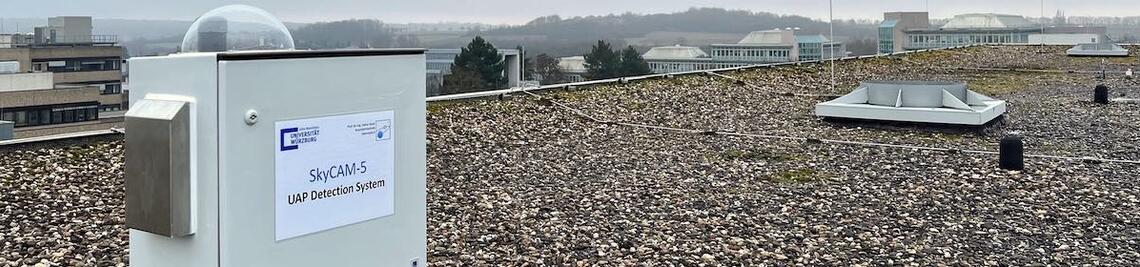
IFEX contributes to the establishment of this emerging field by developing and operating technical systems for the detection, assessment, and analysis of relevant events, as well as by conducting in-depth investigations of particularly informative cases.
The long-term objective is the creation of an integrated research infrastructure — a “system of systems” — designed to enable the acquisition of high-quality, scientifically robust data. To this end, sensor systems specifically tailored to the characteristics of the phenomenon are conceptualized, developed, and deployed in sustained operations. Observational data are systematically collected, examined, and evaluated in accordance with recognized scientific standards.
Close collaboration with relevant authorities, evidence-based advisory support for policymakers, and transparent, responsible communication with the public and the media are likewise of central importance.
Within this context, IFEX understands itself as a central scientific institution for the consolidation, coordination, and partial implementation of related activities. Its objective is to establish sustainable research structures, further develop scientific standards, and anchor the long-term investigation of UAP within institutional frameworks. Reliable support and adequate resources are essential to achieving these goals.
Insights gained from this research have the potential to advance the understanding of previously insufficiently explained observations while also generating impulses for technological innovation as well as for science, industry, and society.
Projects
- VaMEx3-MarsSymphony - Demonstration of communication technologies and sensor systems in realistic exploration scenarios with regard to a future Mars mission in the Valles Marineris region with a UAP element
- UAP reporting system for pilots
- ADEOS - Anomaly Detection an Observation System for UAP's
Selected articles for UAP & SETI
| October 2025 | "UAPs wissenschaftlich erforschen? So geht's! | Harald Lesch | Terra X Lesch & Co", Prof. Kayal talks with Prof. Harald Lesch |
| January 2025 | The New Science of Unidentified Aerospace-Undersea Phenomena (UAP), 2025 |
| 10. July 2024 | Presentation on "Research on Unidentified Anomalous Phenomena (UAP) in Germany", at the Curious 2024 - Future Insight Conference, 2024 (Video from 39:50 mm:ss) |
27. Oktober 2021 | Sachbuch "Expedition ins Sternenmeer, Perspektiven, Chancen und Risiken einer interstellaren Raumfahrt", Harald Zaun (Herausgeber), Buchkapitel Prof. Kayal zum Thema "Extrasolar und exobiologisch - Vom Sinn und Unsinn exosolarer Forschungsexpeditionen", Springer Verlag, Berlin, ISBN: 978-3-662-63729-6 |
21-15 Oktober 2019 | Hyper-SETI - A new Way of searching for extraterrestrial intelligence Hakan Kayal auf dem 70. Internationalen Raumfahrtkongress (IAC), Washington, USA |
08.06.2018 | Workshop zum Thema "Sind wir alleine im Universum?", Workshop des Interdisziplinären Zentrums für Extraterrestrik (IFEX) der Universität Würzburg |
25.09.2017 | A Nanosatellite Mission Concept for Optical SETI, IAC, Adelaide, Australia |
Selected media contributions on UAP research
Search for Extraterrestrial Intelligence (SETI)
The professorship for space technology contributes to the search for extraterrestrial intelligence by conducting studies and developing new concepts for the search. The contributions partially support the work of the Interdisciplinary Research Center for Extraterrestrial Studies (IFEX).
-
2023: Seminarbeitrag zum Thema "Geschichte und Zukunft der UAP Forschung"
-
2021: Design and implementation of an expert system for the evaluation of sighthings of Unidentified Aerospace Phenomena (Masterarbeit)
-
2021: Verwendung von ADS-B Daten zur Verringerung von Fehldetektionen bei der Erdgstützten Suche nach Unidentified Aerial Phenomena am Beispiel des Sky-Cam Beobachtungssystems (Bachelorarbeit)
-
2020: Untersuchungen zur Anomaliedetektion in Bilddaten mittels Deep Learning für Anwendungen in der Raumfahrttechnik (Masterarbeit)
-
2019: Konzept einer terrestrischen Beobachtungsstation für Optical SETI (Bachelorarbeit)
-
2018: Entwurf und Implementierung einer webbasierten Prozessierungssoftware für ADS-B Fluginformationen (Bachelorarbeit)
-
2017: Untersuchung von Algorithmen für Optical SETI an Bord von Nanosatelliten (Bachelorarbeit)
-
2016: Development and Tes of a Software for Capturing and Analysing of Short Sky Phenomena (Masterarbeit)
-
2015: Entwicklung, Implementierung und Test von Algorithmen zur Erkennung von Unregelmäßigkeiten in den Bilddaten von Meteosat Wettersatelliten (Bachelorarbeit)
-
2015: Untersuchung eines Nanosatelliten für die Suche nach intelligenten, extraterrestrischen Signalen im optischen Wellenlängenbereich (OSETI) (Bachelorarbeit)
-
2015: Development, implementtion and test of tools for ADS-B data recording and analysis (Bachelorarbeit)
-
2014: Entwurf und Implementierung einer Software für SkyCam Platformen zur Erkennung von kurzzeitigen Himmelsphänomenen (Bachelorarbeit)
-
2014: Entwicklung, Implementierung und Test einer Sensorplattform für ein Himmelsbeobachtungssystem (Bachelorarbeit)
-
2014: Development of a knowledge based system for a preliminary assessment of unknown sky phenomena (Masterarbeit)